

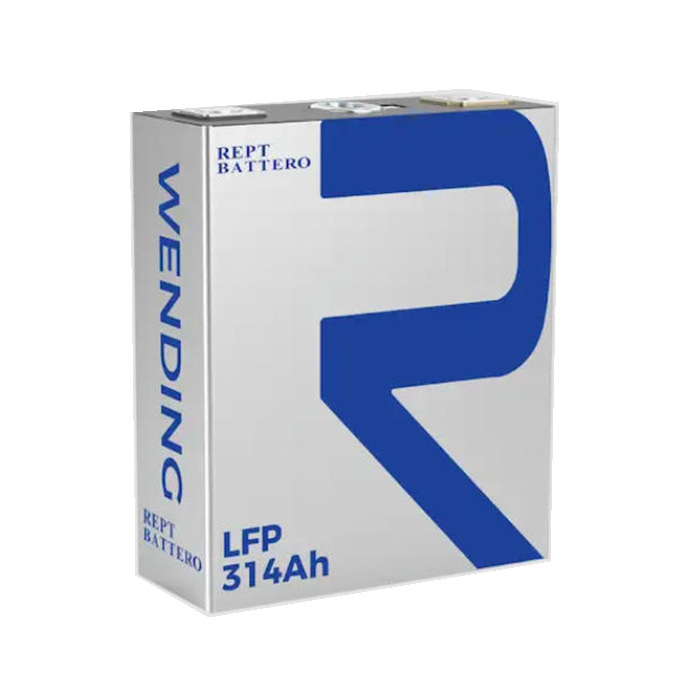
314Ah LFP Prismatic Battery Cell

314Ah LFP Prismatic Battery Cell

Brand: REPT
Product Type: LFP Prismatic Battery Cell
Model: PC-0B1-72174L4-BE
Nominal Capacity: 314Ah
Nominal Energy: 1004.8Wh
Nominal Voltage: 3.2V
Battery Chemistry: Lithium Iron Phosphate (LiFePO4 / LFP)

Send Inquiry

Product Introduction

The 314Ah LFP Prismatic Battery Cell is designed for large-capacity battery energy storage systems and industrial power applications. Using lithium iron phosphate (LiFePO4) chemistry, it delivers a nominal capacity of 314Ah and an energy output of 1004.8Wh per cell. Its prismatic form factor supports efficient integration into battery packs for renewable energy storage, commercial and industrial energy storage, and utility-scale BESS projects.

Key Features

  • High Capacity and Energy Output: With a rated capacity of 314Ah and nominal energy of 1004.8Wh, this LFP cell is suitable for battery systems requiring substantial energy storage capacity.
  • Long Cycle Life: The cell is specified for at least 4,000 cycles at 25°C, with a remaining capacity threshold of 70% SOH under the manufacturer’s defined test conditions.
  • High Energy Density: The cell offers a typical gravimetric energy density of 180Wh/kg and volumetric energy density of 380Wh/L, supporting compact battery system design.
  • Wide Operating Temperature Range: The specified charging temperature range is 0°C to 60°C, while the discharging range is -30°C to 60°C. Actual charging and discharging limits depend on cell temperature and operating conditions.
  • Designed for Battery System Integration: The prismatic design supports integration into larger battery assemblies. A properly designed battery management system (BMS), thermal management system, and mechanical clamping structure are required for safe and reliable operation.

Technical Specifications

ParameterSpecification
ModelPC-0B1-72174L4-BE
Battery ChemistryLiFePO4 (LFP)
Nominal Capacity314 Ah
Nominal Energy1004.8 Wh
Nominal Voltage3.2 V (calculated; confirm with supplier)
Operating Voltage Range2.5–3.65 V (cell temperature > 0°C); 2.0–3.65 V (cell temperature ≤ 0°C)
Internal Resistance≤ 0.25 mΩ (at 1 kHz)
Standard Charge Rate0.5C
Standard Discharge Rate0.5C
Maximum Continuous Discharge Rate1C at 25 ± 2°C
Maximum Pulse Discharge Rate2C for 30 seconds at 25 ± 2°C
Charging Temperature0°C to 60°C
Discharging Temperature-30°C to 60°C
Storage Temperature-40°C to 60°C
Recommended SOC Range5%–95%
Cycle Life≥ 4,000 cycles to 70% SOH under specified test conditions
Gravimetric Energy Density180 Wh/kg (typical)
Volumetric Energy Density380 Wh/L (typical)
Weight5.5 ± 0.2 kg
Dimensions (W × T × H)174.0 ± 0.8 × 71.75 ± 0.50 × 206.9 ± 0.8 mm
Maximum Application Altitude≤ 5,000 m

Technical notes: Internal resistance is specified for a fresh cell at 20%–40% SOC. Thickness is measured under a clamping force of 300±20kgf. Cycle-life performance is based on the manufacturer's specified test procedure, including a 300±20kgf preload and a 0.5–1.0mm gap. Actual results vary with operating conditions and system design. Please confirm the latest datasheet before final product selection.

Typical Applications

  • Utility-Scale Battery Energy Storage: Used as a cell-level component in large battery energy storage systems.
  • Commercial and Industrial Energy Storage: Suitable for battery systems supporting energy management in commercial and industrial facilities.
  • Solar Energy Storage: Can be integrated into battery assemblies for storing electricity generated by photovoltaic systems.
  • Renewable Energy Projects: Supports energy storage system designs for renewable power integration.
  • Industrial Power Systems: Suitable for engineered battery assemblies used in stationary power applications.

Integration Considerations

For reliable system operation, this cell should be used with a compatible battery management system (BMS) that monitors cell voltage, current, and temperature. Battery pack design should also account for thermal management, mechanical clamping, electrical insulation, and overcharge and over-discharge protection.

Charging and discharging must remain within the manufacturer’s specified limits. System integrators should confirm compatibility with the intended operating environment and battery configuration before deployment.

Request a Quote for 314Ah LFP Battery Cells

Looking for 314Ah LFP prismatic battery cells for your next energy storage project? Contact ALLBLUE to discuss product availability, technical documentation, and bulk purchasing requirements.

Send us your project requirements to request a quotation and further product information.

滚动至顶部