

DC fast charging allows electric vehicles (EVs) to recharge much faster than conventional AC charging. But how does electricity travel from the grid to the vehicle's battery, and why does charging power change during a session?
The answer lies in four key stages: power conversion, safety checks, system monitoring, and dynamic power control. Each stage depends on components working together reliably.
Power Conversion: From AC to DC
The electricity supplied by the grid is typically alternating current (AC), while an EV battery requires direct current (DC).
With AC charging, the vehicle's onboard charger converts AC into DC. With DC fast charging, this conversion takes place mainly inside the charging station.
DC charging modules perform this essential task. Multiple modules can be configured to meet a charger's required output capacity, depending on the system design. Their conversion efficiency, thermal performance, and output stability directly affect charging equipment performance.
For example, a 40 kW charging system needs to deliver up to 40 kW of output power under its specified operating conditions. The actual power available to a vehicle will depend on the charger's configuration, the vehicle's charging limits, and other operating conditions.
For charging equipment manufacturers, selecting compatible DC charging modules is an important step in building a reliable charging system.
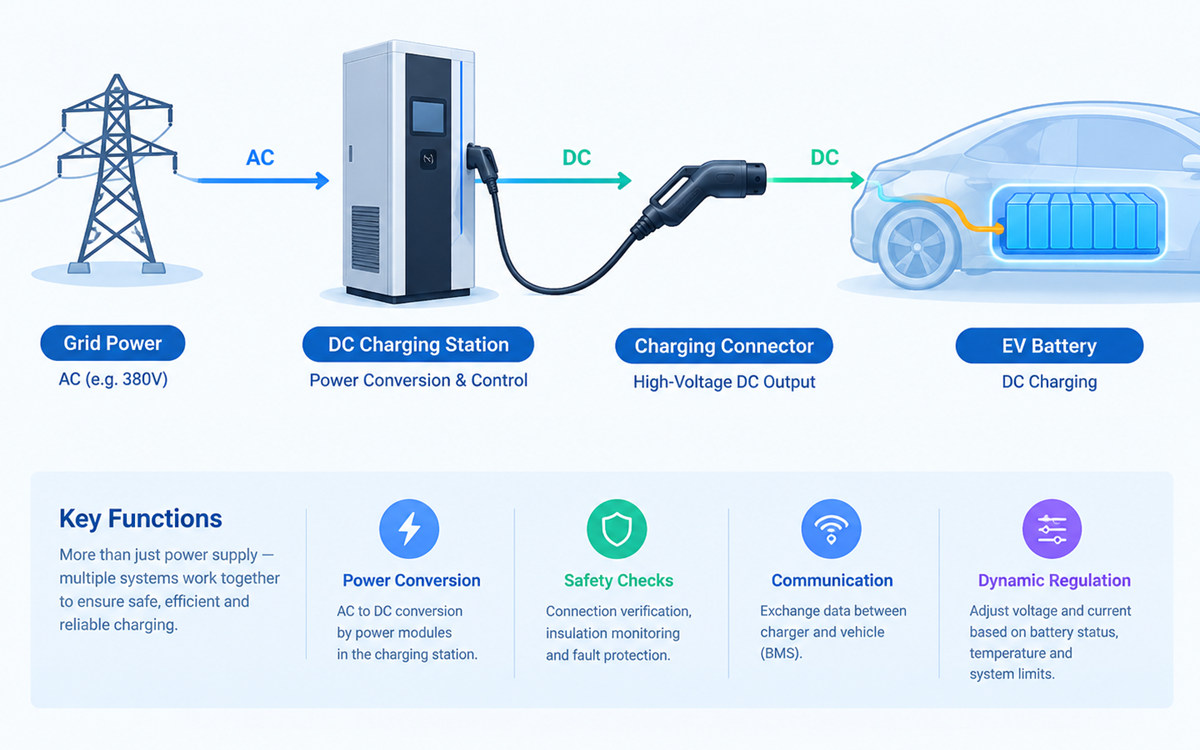
Safety Checks: Why Charging Doesn't Start Immediately
Plugging in the connector does not mean that high-voltage power starts flowing immediately.
Before charging begins, the vehicle and charging station must confirm the connection, perform the required electrical safety checks, and establish communication.
The battery management system (BMS) reports the battery's charging requirements. The charging station then adjusts its output voltage and current according to the vehicle's requests and the system's operating limits.
Contactors are another important component in many charging systems. These electrically controlled switches connect or disconnect power circuits as required by the system design and safety controls.
Correct contactor selection helps ensure that switching performance, current rating, and voltage rating match the intended application.
Monitoring: Why Charging Power Changes
A DC fast charger rated at 120 kW does not necessarily deliver 120 kW throughout a charging session. Actual charging power depends on both the vehicle and the charging equipment.
Three factors are particularly important:
Electrical measurement is also important for monitoring system performance. Depending on the design, meters can measure parameters such as voltage, current, power, and energy consumption.
For example, a DC energy meter can help charging equipment operators monitor the energy delivered during a charging session. Communication interfaces, such as RS485, may also allow measurement data to be collected by a monitoring or management system when supported.
Explore ALLBLUE's energy meters for EV charging applications to find products suited to your equipment requirements.
Dynamic Control: Keeping the System Working Together
During charging, the system continuously responds to changing conditions. The charger regulates its output according to the vehicle's requirements. Measurement devices provide electrical data, while control circuits and contactors perform their respective monitoring and switching functions.
These components serve different purposes, but their compatibility matters. Incorrect ratings, unsuitable interfaces, or mismatched operating requirements can affect the overall system design.
When sourcing components, equipment manufacturers should consider voltage and current ratings, communication requirements, thermal conditions, and the intended operating environment—not just the headline specifications.
Sourcing Components for DC Charging Equipment
DC fast charging is not simply a matter of installing a high-power charger. Reliable performance depends on power conversion, electrical protection, measurement, and coordinated control.
ALLBLUE supports B2B customers with sourcing and procurement of electrical and electronic components, including DC charging modules, energy meters, and contactors.
If you are developing charging equipment or sourcing components for an existing design, contact ALLBLUE with your required specifications. Our team can help you identify suitable products for your procurement needs.