

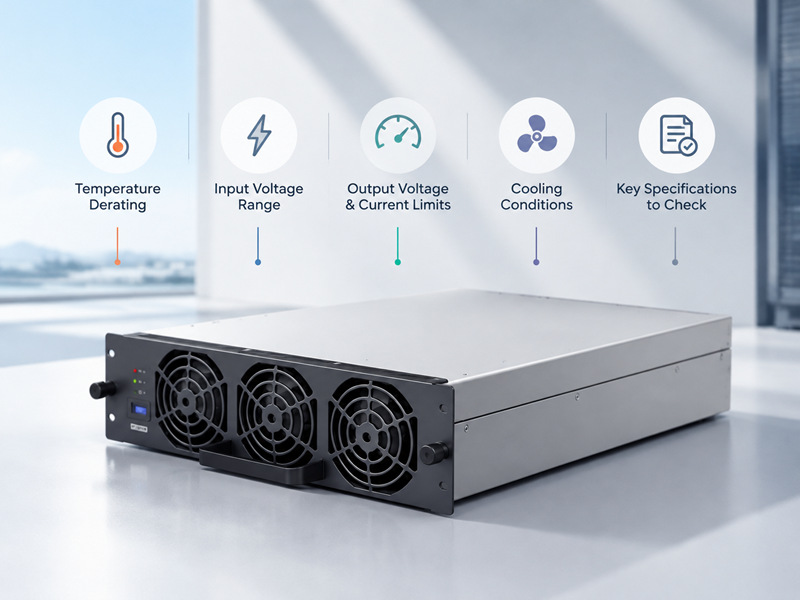
Temperature and Power Derating
Temperature is one of the most critical factors affecting the output of charging modules.
It is well known that modules generate heat during operation. As heat accumulates, the cooling system's heat dissipation capacity diminishes. To protect internal components, some modules automatically reduce their output power when the temperature exceeds a specific threshold.
Specific thresholds and power derating levels vary by brand and model. For instance, while manufacturers like InfyPower and Tonghe both offer 20kW modules, their threshold parameters are not identical.
When comparing different modules, one should consult the manufacturer's specifications regarding full-power operating temperatures and temperature derating curves; one should not simply assume that all 20kW modules deliver the same output power under high-temperature conditions.
How Input Voltage Affects Output Power?
Charging modules must operate within their specified input voltage ranges. If the input voltage falls outside optimal operating conditions, the module may limit its output to ensure safe and stable operation.
Input voltage requirements vary across different products. For instance, while both are 30kW charging modules, InfyPower’s REG1K0100A2 is designed for three-phase AC input and supports a wide input range of 260Vac to 530Vac, whereas another brand’s model, the XYR1K0100UR, has an input voltage range of 260–456Vac.
For system integrators and equipment purchasers, this means that power supply conditions at the installation site must be verified before selecting a module. A product's nominal rated power alone does not guarantee that it can deliver the required output under all input conditions.
Output Voltage and Current Limits
Even when temperature and input conditions are suitable, the module's output voltage and current limits can restrict its available power.
The basic relationship is:
For example, delivering 20kW at 500V requires 40A of output current. If a module is limited to 30A at that operating voltage, its output would be limited to 15kW.
For example, delivering 20kW at 500V requires 40A of output current. If a module is limited to 30A at that operating voltage, its output would be limited to 15kW.
Cooling and Installation Conditions
A module's cooling method can affect how reliably it maintains its rated output.
Depending on the design, charging modules may use forced-air cooling or other thermal management arrangements. The installation must provide the airflow, clearance, and environmental conditions required by the manufacturer.
For example, installing a module in a tightly enclosed cabinet without adequate ventilation may cause temperatures to rise and trigger power derating. Dust accumulation or a malfunctioning cooling fan can also affect thermal performance.
What to Check Before Buying a Charging Module
When comparing charging modules, look beyond the rated kilowatt value. The following specifications can help determine whether a module is suitable for your application:
Always use the datasheet for the specific model. Derating thresholds and operating limits can vary significantly between manufacturers and product series.
Find the Right Charging Module with Allblue
Selecting a charging module requires more than matching a power rating. The module must also suit the application's voltage and current requirements, operating environment, and installation conditions.
Allblue provides genuine charging power modules across a wide range of power ratings and brands, helping customers source products for different charging-system requirements through one supplier.
Whether you are looking for a specific module model or comparing options across different power levels, Allblue supports one-stop sourcing to simplify purchasing and supplier coordination.